
Kindergarten enrollment prompts reflection on our Alagille journey
At one point, I wasn't sure if Finley would ever be able to attend school
Written by |


Everyone always says that time flies when you are raising kids. Many have told me that one day, you blink, and they’ve gone from crawling to driving. While I’m not at that point yet, I sure feel like I’m on a speeding train of development and change — especially after enrolling my youngest son, Finley, who was born with Alagille syndrome, in kindergarten for the fall.
When Finley was a newborn, there were multiple moments when I worried he might never attend school. At that point, his health was so uncertain, and we didn’t have a diagnosis. After hearing the dreaded words “failure to thrive” and witnessing his lack of growth, it was hard to see a path forward and remain optimistic.
During the diagnostic process, when Finley was about 1, I asked the doctors at our children’s hospital if he’d be able to attend school one day. Of course, they tried to stay positive, but it was still so early in our journey; there were many unknowns, and much of the story had yet to be written. I didn’t know what Finley’s future would look like.

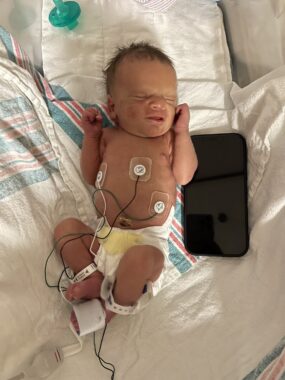
Finley lies next to a phone in the neonatal intensive care unit five years ago. (Photo by Jay Sandstrom)
I don’t take for granted that Finley’s health has been mostly stable for the past five years. He may not be on the growth chart, but he is growing and following his own curve. His liver is stable and his treatment is consistent, mainly focusing on nutrition.
Finley sees a variety of specialists throughout the year, mostly to track his progress. Outside of doctor appointments and medications, his life is like that of any other 5-year-old. I have to remind myself that there was a time when I wasn’t sure that would ever happen.
So when I sat down with my laptop to complete his kindergarten registration recently, it hit me right between the eyes: We’ve reached the next major milestone.
Each kid hits milestones on their own time, but it was almost impossible for my wife, Dani, and me not to worry about whether Finley was crawling at the right time, eating at the right time, and more. His Alagille syndrome caused us to focus intently on his development early on, but as time goes on, and Finley does well, Dani and I have both eased up.
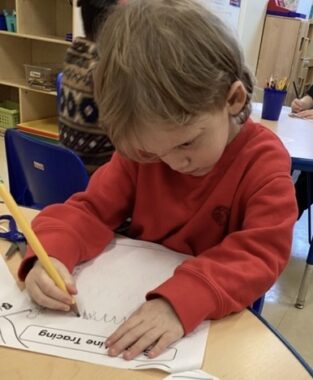
Finley is working hard to prepare for kindergarten this fall. (Courtesy of Jay Sandstrom)
But starting elementary school is a major milestone. Finley has been at the same day care center since he was an infant. He is familiar with it, and the staff is familiar with him. He will be starting fresh at a brand-new place where no one knows him and has never heard of Alagille syndrome. Obviously, I plan to work with the school to get him any help and support he needs, but I’d be lying if I said I wasn’t worried. Isn’t everyone a little worried about sending their kid to school for the first time? Will they make friends? Will they fit in? And those questions usually don’t account for rare diseases!
When these concerns arise, I think about Finley. He may be smaller in stature than his peers, but his personality makes up for it. He is outgoing, emotive, and adventurous. Like any kid, I’m sure he’ll be nervous at first, but I’m not worried about him in the long run. I think he will ultimately excel. He is a smart kid who has made friends everywhere he’s gone. I’m the one who needs to work through my own fears and trust that he will do great in kindergarten.
Note: Liver Disease News is strictly a news and information website about the disease. It does not provide medical advice, diagnosis, or treatment. This content is not intended to be a substitute for professional medical advice, diagnosis, or treatment. Always seek the advice of your physician or other qualified health provider with any questions you may have regarding a medical condition. Never disregard professional medical advice or delay in seeking it because of something you have read on this website. The opinions expressed in this column are not those of Liver Disease News or its parent company, Bionews, and are intended to spark discussion about issues pertaining to liver disease.


Leave a comment
Fill in the required fields to post. Your email address will not be published.