
Who would’ve guessed a child growth chart would be my nemesis
Given the earlier challenges of my son's Alagille journey, I'll take it
Written by |

Raising my son Finley, who was born with Alagille syndrome, has taught me to adapt to countless challenges, including new medications, unfamiliar terminology, and ever-shifting routines. Yet one of the hardest realities to accept, and one that will linger throughout Finley’s life, is the growth chart. More specifically, where he falls, or doesn’t fall, on the chart.
That chart has been my nemesis since Finley was in the womb. Throughout my wife’s pregnancy, he consistently measured small and ultimately arrived a month early, weighing just 5 pounds. Even after delivery and a two-week stay in the neonatal intensive care unit, Finley remained tiny, below the third percentile in both weight and length. He would remain there for quite some time.

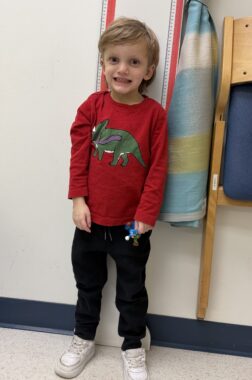
Columnist Jay Sandstrom’s son Finley, who has Alagille syndrome, loves getting measured at the doctor’s office. (Photo by Jay Sandstrom)
Seeing the U.S. Centers for Disease Control and Prevention growth chart for kids his age and watching his number fall so far below average was demoralizing. This was especially painful in the early days, when his diagnosis was still fresh and uncertainty loomed over everything. Watching him chart so low made me feel like I was failing as a parent because he wasn’t getting what he needed. Even worse, it sometimes felt as if, no matter how much we gave him, it might never be enough.
Thankfully, Finley continued to grow and develop, even if he remained small for his age. At 5 years old, he still wears size 3T clothing, but I gladly accept that because the challenges we faced earlier were far greater.
Finding shoes that fit when he was learning to walk was a task I never expected. He was eager to explore, but shoes with sturdy soles for outdoor play were nearly impossible to find. For a time, he was stuck in crib shoes, shuffling around in soft soles. That period was a constant, tangible reminder that he was different from his peers.
As he grows, Finley continues to follow his own unique growth curve. Our doctors are pleased with his progress; even though he’s still small, the fact that he’s following a consistent curve is exactly what they hope to see. He’s even begun to touch the low end of the height chart, which feels like a small victory.
I still get discouraged when his weight plateaus for long stretches, but I remind myself that this is part of the journey of raising a child with Alagille syndrome. As long as he’s growing at his own pace, that’s something to celebrate.
I’m grateful that, in the grand scheme of Finley’s Alagille journey, one of my greatest struggles is simply facing the growth chart. When I reflect on my earlier fears — wondering if all our efforts might somehow fall short — I shudder to imagine if things had not improved.
For now, I’ll continue to dislike the growth chart, but I’ll celebrate every milestone on Finley’s own curve. Every pound and every inch gained is a triumph, because he’s doing wonderfully, no matter what the chart says.
Note: Liver Disease News is strictly a news and information website about the disease. It does not provide medical advice, diagnosis, or treatment. This content is not intended to be a substitute for professional medical advice, diagnosis, or treatment. Always seek the advice of your physician or other qualified health provider with any questions you may have regarding a medical condition. Never disregard professional medical advice or delay in seeking it because of something you have read on this website. The opinions expressed in this column are not those of Liver Disease News or its parent company, Bionews, and are intended to spark discussion about issues pertaining to liver disease.



Leave a comment
Fill in the required fields to post. Your email address will not be published.