New ALF board chair turned personal loss from MASH into public advocacy
Before his mother's death, advocate 'had never even heard of the disease'
Written by |
David Frank, who lost his mother to a severe form of steatotic liver disease and has since become a strong liver health advocate, is the newly elected chair of the board for the American Liver Foundation (ALF).
Frank hopes to use his tenure to continue both advocating and pushing the organization forward to help the approximately 100 million people in the U.S. who have liver disease — “a public health issue that the country can no longer afford to treat as secondary,” Frank told Liver Disease News in a written Q&A. He wants his term, among other things, to increase the focus on children and adolescents, and in patient populations “where the burden is … greater, including parts of the Hispanic community.”
“For me, while the aspirations are lofty, the goal is simple: continue growing ALF’s reach, deepen its impact, and make sure we are matching the scale of this crisis with the seriousness it demands,” the new chair said.
Frank, who works as senior product manager for equities cash and derivatives at Wells Fargo Securities in New York City, first became involved with ALF more than a decade ago. His journey with liver advocacy began in 2014, when his mother died from metabolic-associated steatohepatitis (MASH).
MASH, previously known as non-alcoholic steatohepatitis (NASH), is a severe form of steatotic liver disease in which the buildup of liver fat leads to inflammation and scarring, or fibrosis, that can interfere with liver function.
The condition is incredibly common, estimated to affect about 1 of every 20 adults in the U.S. But because symptoms often don’t become obvious until there is already life-threatening liver damage, many people don’t know that they have the disease until it’s advanced.
That’s what happened with Frank’s mother: She died only six weeks after being diagnosed with MASH. She was 62.
“Like most people, I had never even heard of the disease before it took her from us,” Frank said. “That experience changed me. It was shocking, disorienting, and deeply painful, not only because of how quickly we lost her, but because it felt like the disease had been hiding in plain sight.”

The condition’s hidden progression is “one of the cruelest things about MASH and related liver diseases,” according to Frank.
“They can be incredibly common, incredibly serious, and yet remain largely invisible until the damage is already advanced,” Frank said.
Losing his mother spurred Frank’s advocacy efforts
After losing his mom, Frank delved into liver advocacy: He joined ALF as a volunteer, began speaking out as an advocate, and launched a blog called NASH AWARE that’s dedicated to raising MASH awareness. Most recently, he’s served as the vice chair of ALF’s board since March of 2025.
“After my mother died, I struggled with the same things many families struggle with after a sudden loss: grief, guilt, confusion, and the need to understand what happened,” Frank said. “I’m someone who copes by learning and doing, so I started researching liver disease and looking for ways to help. That led me to the American Liver Foundation, where I started as a volunteer and gradually became more deeply involved over time.”
According to Frank, “what began as a response to personal loss became a broader commitment to helping other people avoid that same shock and helplessness.”
“In many ways, advocacy gave my grief somewhere to go,” Frank said. “It did not make the loss easier, but it gave it purpose.”
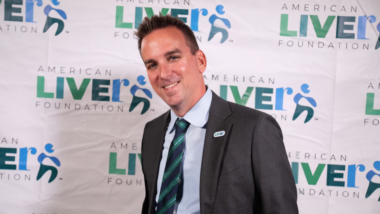
David Frank is pictured at an American Liver Foundation event. (Courtesy of ALF)
A frequent speaker at MASH conferences and International MASH Day events, Frank now encourages people who are living with the condition or other liver diseases to remember that they are not alone, and to feel empowered to ask questions and advocate for themselves.
“Liver disease can be overwhelming. … The terminology is confusing, the medical system can feel intimidating, and the emotional weight of a serious diagnosis is enormous,” he said. “Whether it comes from family, friends, advocacy groups, physicians, or patient communities, having people around you who understand the seriousness of what you are facing can make a real difference. When you are dealing with a silent disease, one of the most powerful things you can do is refuse to suffer through it silently.”
In his tenure as ALF’s board chair, which will last three years, Frank hopes to continue his efforts to increase advocacy. But he stressed that it’s not enough to merely raise awareness about liver disease; he hopes to actually change outcomes.
“People use the word ‘awareness’ a lot, and of course it matters. But awareness that does not lead to earlier diagnosis, better education, stronger policy, more research, or better support for patients is not enough,” Frank said.

Some key lessons already learned by the new ALF board chair
During his years as an advocate, the new ALF board chair has taken several lessons to heart: For one, change comes slowly, so it’s crucial to be persistent about pushing for it. Personal stories matter, because behind every statistic there are people struggling.
For another: Stigma remains a key opponent in the battle to improve liver health outcomes.
“If people feel embarrassed, judged, or dismissed, they are less likely to ask questions, less likely to seek help, and less likely to be heard,” Frank said. “Stigma can make this journey harder than it needs to be.”
Frank hopes to carry these lessons forward into his tenure as board chair.
“That’s the mindset I want to bring to this role as board chair: patient-centered, persistent, and focused not just on visibility, but on real impact.”
If people feel embarrassed, judged, or dismissed, they are less likely to ask questions, less likely to seek help, and less likely to be heard. … Stigma can make this journey harder than it needs to be.
In recent years, ALF has remained committed to promote change in the liver disease field. In addition to scores of advocacy initiatives, the foundation launched a first of its kind living donor network. The organization also has invested millions in liver-focused research and launched a public health campaign to increase awareness about the risk of MASH and related diseases.
Frank succeeds outgoing ALF board chair Emmanuel Thomas, MD, PhD, a professor at the University of Miami School of Medicine. Chairs of the ALF board serve three consecutive one-year terms, according to the nonprofit.
“We are so grateful for David’s leadership and vision as he takes the helm of ALF to lead us through these coming years offering his dedication, passion, and vision for millions of Americans living with liver disease,” Thomas said in a press release from ALF.