
Changing backpacks is the right fit for my son with Alagille syndrome
Finley was excited to have his very own backpack, but his first choice was too big
Written by |

My wife, Dani, and I have been working to help our son Finley navigate kindergarten, which he just started six weeks ago. It hasn’t been without some some obstacles, one of which has been getting Finley’s backpack right.
When it was time for school shopping, Finley was very excited to get his very own school backpack. He had a cool one he had gotten on vacation, but it was not going to work for school, so to the the internet we went, and Finley picked out a sweet Pokemon backpack.
The challenge Dani and I faced — one we are all too familiar with — is what size to order.
Finley was born with Alagille syndrome and, at age 5, weighs about 32 pounds, so he is smaller than his peers. Still, we thought it would be a good idea to get one that was a big big on him now, that he could fit everything into, but that he could use a long time and eventually grow out of. That’s what his brother, Jackson, did; so we ordered the bigger one.

Too big of a backpack
The backpack arrived before the first day of school and Finley was so excited to have it. We packed it all up for the first day, and, while it did fit, it was a bit big, and I started to notice that Finley didn’t want to keep it on. He began to ask me to carry it for him or he would come off the bus with it in his hand, instead of on his back. Still, it was his backpack, and he wanted to use it, despite all the signs showing it wasn’t working.
-
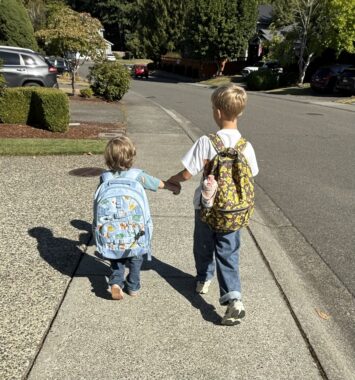
Finley (left), wearing the backpack that his parents decided was too big for him, walks home from school with his brother, Jackson, who is wearing the backpack Finley would eventually begin using. (Photo by Jay Sandstrom)
I found myself getting discouraged. Finley’s stature is the one thing I have no control over, and it was getting in the way of his experience.
My son’s Alagille diagnosis is not something I think about every day. Even when I am pulling his medicine in the morning and evening, I’m not really connecting it to his diagnosis. It’s just a normal part of our daily routine.
But when I see other kids at the bus stop with the same backpack type as Finley having no issues, reality hits. Finley is different and, unfortunately, these are the ways it shows up. And I haven’t even mentioned the giant bus steps he has to go up and down each day.
We cannot change his growth pattern or the giant bus steps, but we can try another backpack.
And thankfully, Finley was excited to try out the one his brother used to use. This backpack also just so happened to be Pokemon, which helped, and it’s a less structured bag, so the looser material drapes better over Finley’s shoulders. H is no longer walking off the bus with his backpack in his hand or asking me to carry it home for him. The fix was found.
Finley is still dealing with a lot of life changes, and it has not been a slow fall, by any means. Along with kindergarten, he is playing soccer for the first time and is also keeping up with swim lessons every week. Navigating these obstacles will be something Finley will always need to do, just like we all do. But with Alagille as an extra variable, I continue to find ways to support him as we find the best route forward.
Note: Liver Disease News is strictly a news and information website about the disease. It does not provide medical advice, diagnosis, or treatment. This content is not intended to be a substitute for professional medical advice, diagnosis, or treatment. Always seek the advice of your physician or other qualified health provider with any questions you may have regarding a medical condition. Never disregard professional medical advice or delay in seeking it because of something you have read on this website. The opinions expressed in this column are not those of Liver Disease News or its parent company, Bionews, and are intended to spark discussion about issues pertaining to liver disease.
Leave a comment
Fill in the required fields to post. Your email address will not be published.