
Guest Voice: I donated a part of my liver. You can, too!
Living Donor Network connects willing donors with patients in need of a transplant
Written by |

I just did a nondirected liver donation! A piece of my liver was transplanted into a stranger in need. I’m going to tell you about the process I went through so you can consider whether that might be something you’d like to do, too.
My journey began when I wrote an article about the launch of the American Liver Foundation‘s (ALF) Living Donor Network, which seeks to streamline nondirected donations so willing donors can be matched with patients. The main requirements are being a healthy adult, having a support system for recovery, and having the ability to take time off work.
As I was writing the article and outlining these requirements, I thought, “I could do that.”

A potential donor
Signing up online for the registry took about an hour, and based on my responses, the registry determined I was a potential candidate. It then presented me with a list of transplant centers near me. I selected Northwestern Medicine Organ Transplant Center in Chicago because it’s closest to my parents, whom I planned to lean on for childcare and recovery assistance.
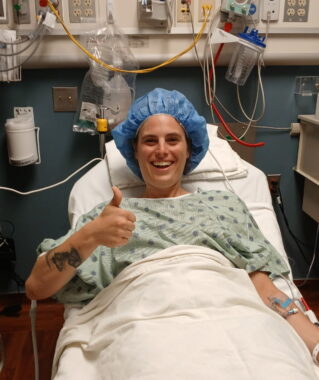
Marisa Horak prepares for liver donation surgery in June. (Courtesy of Marisa Horak)
After signing up, Northwestern contacted me to schedule an in-person screening. This took a full day and involved meeting various providers one-on-one (surgeon, hepatologist, social worker, psychiatrist, nurse) to go over my medical history and reasons for pursuing donation, followed by tests and imaging of my liver to determine if I was healthy enough.
The purpose of this intensive screening is to find any excuse to rule out potential donors. Because donation is voluntary, if there’s any reason to think it will be unsuccessful or dangerous, they’ll say no.
About a week later, I got the call that my liver was “beautiful,” and I’d be a good candidate. Because my wife is a teacher, we scheduled the donation for early June to line up with summer break. I was informed in May that they’d identified a recipient, and everything was good to go.
My first pre-op appointment was two weeks before the procedure. This consisted of a call with the head transplant nurse and several family members. We went over everything to expect, with the nurse offering advice from her decades of experience.
My next pre-op appointment was two days before the surgery — more tests to make sure everything was looking good, then more talking to iron out last-minute details.
Surgery, and then some
Then it was surgery day! I got to the hospital at 6 a.m., and around 8 a.m., the anesthesiologist said, “OK, we’re going to put you to sleep now.” Then it was 6 p.m., and I was waking up in the intensive care unit (ICU), where I was informed that the procedure had been completed successfully!
I spent about 24 hours in the ICU, which is standard. Fortunately, there were no major complications.
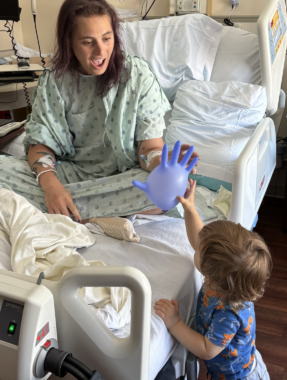
Marisa Horak receives a visitor in the hospital while recovering from liver donation surgery. (Courtesy of Marisa Horak)
After a night, I was transferred to a standard hospital ward for further recovery. This involved checking my vitals, waiting until my digestive system was back online enough to fart, and giving me pain medications. I had expected the pain to be extreme, but with the meds, it wasn’t too bad. Breaking up with my high school girlfriend hurt more.
The hospital ward stay lasted another two nights, then the hospital put me up in a hotel room next door so I could continue recovering in close proximity. Again, this is standard procedure for Northwestern. It was pretty sweet — I watched trashy reality TV with my cousin, taking breaks every hour to walk around (to promote recovery and reduce risk of blood clots).
I still had a tube in my tummy to drain fluid, which was a bit uncomfortable, but perfectly manageable. They took out the tube at my first post-op appointment and reviewed rules for the rest of recovery, the biggest being that I couldn’t lift anything heavier than 10 pounds — including my almost-2-year-old — for six weeks until the incision fully healed.
After that appointment, I recovered at home. Not being able to lift my kid was by far the most difficult part, but it was manageable. We cuddled a lot, and I was able to turn to my wife and parents when lifting was required. Now, less than two months later, I’m pretty much fully recovered.
I’m deeply grateful to have had this experience and hope that sharing it may inspire others to consider becoming donors. There are thousands of people in need of liver donation in the U.S. alone, and with the ALF’s registry and modern surgery and recovery techniques, it’s literally never been easier.
If you think you might be interested and suited for the process, please think about it and talk to your doctor. And if you have questions, please contact Bionews, the publisher of Liver Disease News, to reach me. I’m happy to answer what I can.
Note: Liver Disease News is strictly a news and information website about the disease. It does not provide medical advice, diagnosis, or treatment. This content is not intended to be a substitute for professional medical advice, diagnosis, or treatment. Always seek the advice of your physician or other qualified health provider with any questions you may have regarding a medical condition. Never disregard professional medical advice or delay in seeking it because of something you have read on this website. The opinions expressed in this column are not those of Liver Disease News or its parent company, Bionews, and are intended to spark discussion about issues pertaining to liver disease.

Leave a comment
Fill in the required fields to post. Your email address will not be published.