
Cats don’t get MASH, but they can still get fatty liver disease
My own experience has made me alert to signs of health issues, even in pets
Written by |

My daughter and I share a special bond built on inside jokes, beloved movies (I introduced her to “Mean Girls,” now her favorite), and our love for three cats.
Our oldest, Bruce Lee, also responds to “Little British Kitty Boy” and “Princess Bruce.” He is a lovable, fat curmudgeon who rarely meows unless someone violates his personal boundaries. Then, a gentlemanly cry of discontent escapes his furry face.
Today was Brucie’s weigh-in day. He no likey.
Bruce is a big boy: a gray, brown, and white tabby with four white paws and a generous belly. He is our portly statesman who quietly rules the house, or so he thinks. Our household’s true Cat Executive Officer is Ruth Bader-Ginspurrg, but that is a story for another day.
Today, Bruce Lee weighs 19 pounds. I am worried.

I hate to publicly fat-shame my cat, but Bruce is more than an adorable chonk. He has slowly gained weight over his five years of life. When you write about liver disease every week and live with metabolic dysfunction-associated steatohepatitis (MASH), you become alert to signs that someone you love may be struggling — even a pet. While I adore fat kitties, I do not adore sick ones.
Bruce spends his days on my bed or wherever I am, usually no more than 2 feet away. He often lies on his back with his fluffy belly exposed and his little white paws raised in the air. He resembles a dead bug that has surrendered to gravity. It is funny to see, but the reason he may struggle to contort himself is less amusing.
Should you be concerned about your pet’s liver? Yes.
Protecting my cats’ health
Cats do not develop MASH, but they can develop feline hepatic lipidosis, commonly called fatty liver disease. It often occurs after a cat stops eating, particularly when the animal is overweight or obese. According to the Cornell Feline Health Center, anorexia is commonly linked to another underlying condition.
This is also why putting an overweight cat on a crash diet is dangerous. A veterinarian should supervise any weight-loss plan for a cat so the animal continues receiving adequate nutrition.
If your cat has not eaten properly for 24 hours, seek veterinary attention. Feline hepatic lipidosis can become life-threatening. This is not a disease to diagnose or treat with internet advice and a hopeful shrug.
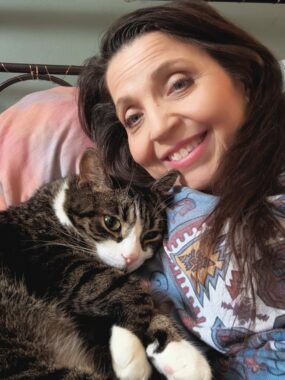
Columnist Kathryn Hudson snuggles with her cat Bruce Lee. (Photo by Kathryn Hudson)
I am already looking for ways to help my large-and-in-charge boy. I plan to make appointments for all three cats with a mobile veterinarian whose RV clinic comes to our house. That will spare me the three-part symphony of transporting three frightened, yowling cats by car. After their examinations, they can return home and give me the side-eye for the rest of the day.
Our youngest, Houdini, is a 13-pound Maine coon mix whose size fits his frame. He joined us last year after a neighbor and I heard tiny, helpless meows coming from beneath a car after a sudden summer rainstorm.
Ruthie, meanwhile, was a young homeless mother I scooped up three years ago. She is tiny, healthy, and fully convinced she runs the place.
But dear Brucie cannot continue down his current path. It is a path I recognize. My own eating and drinking habits contributed to the liver disease I live with today. I cannot change the past, but I can help protect Bruce’s future.
I have written before about how my cats make living with MASH easier. As I prepare for bed, Bruce is waiting for me to settle in so he can curl against my right arm. I hope we can cuddle like this for many years.
Pets are not merely animals sharing our homes. They are family. In Hawaii, pet owners are called “kahu,” meaning “protector.” Helping Bruce reach a healthier weight safely is one way I can honor that responsibility — even if Princess Bruce registers his disapproval with a very British complaint.
Note: Liver Disease News is strictly a news and information website about the disease. It does not provide medical advice, diagnosis, or treatment. This content is not intended to be a substitute for professional medical advice, diagnosis, or treatment. Always seek the advice of your physician or other qualified health provider with any questions you may have regarding a medical condition. Never disregard professional medical advice or delay in seeking it because of something you have read on this website. The opinions expressed in this column are not those of Liver Disease News or its parent company, Bionews, and are intended to spark discussion about issues pertaining to liver disease.

Leave a comment
Fill in the required fields to post. Your email address will not be published.